
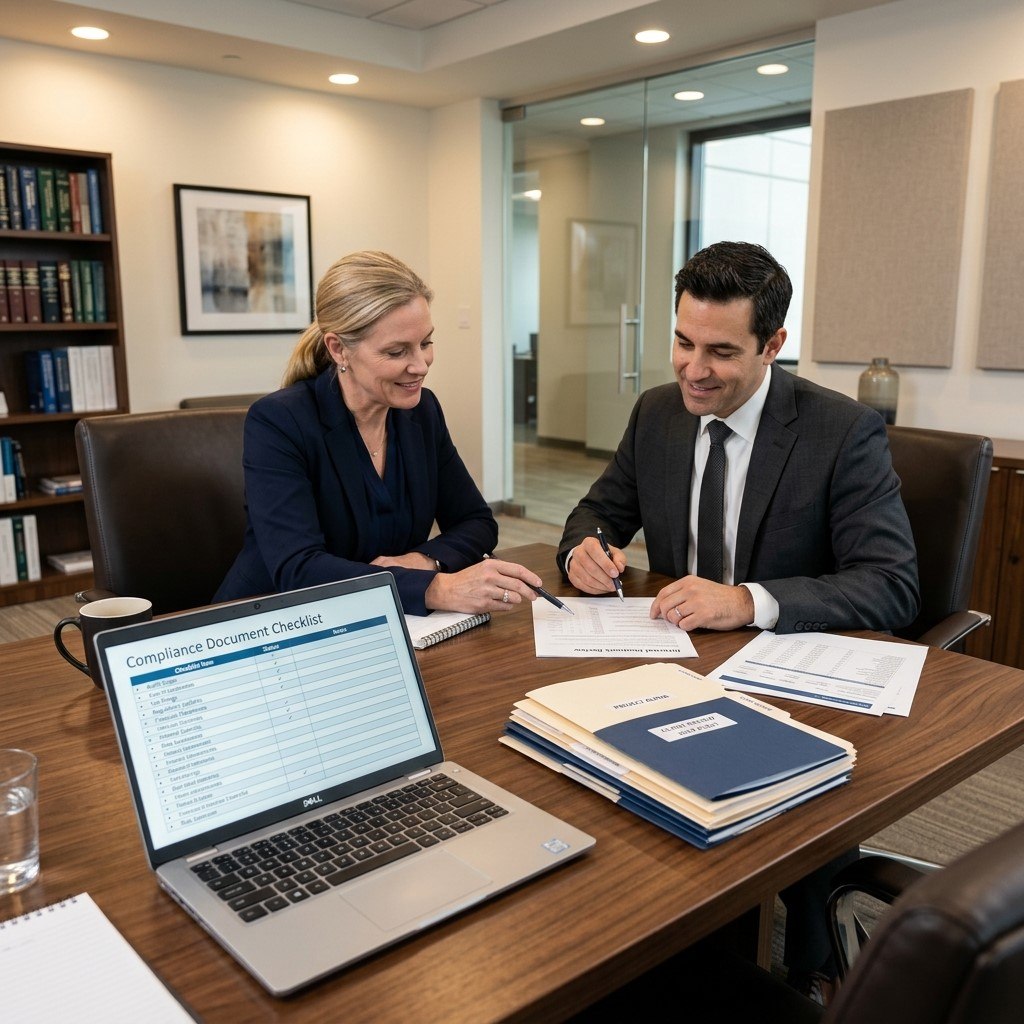
Year-End Compliance Checklist for Accounting Firms
For accounting firms, Q4 is not just about closing books for clients. It is the window to close your own compliance gaps before tax season volume makes it nearly impossible to stop and think. The firms that invest a few focused hours now save dozens of reactive hours come January.
Why It Matters
Accounting firms sit at the center of some of the most sensitive data in existence: tax returns, payroll records, financial statements, personal identification numbers. That exposure creates a compliance profile that is more demanding than most firms treat it.
The FTC Safeguards Rule applies broadly to businesses that handle consumer financial data, and many accounting firms qualify. The IRS requires a Written Information Security Plan (WISP) for any preparer handling federal returns. State-level privacy laws continue to multiply and carry their own documentation requirements. And when a client or a regulator asks "what controls do you have in place?" you need a documented, current answer, not a best guess.
The gap most firms face is not ignorance of the rules. The rules were addressed once, and then time passed. Access controls went stale. Policies were not updated after a staff change. Vendor agreements were never revisited after a software switch. Q4 is when that accumulated drift becomes a real problem.
How It Impacts Accounting Firms
There are two ways compliance drift shows up, and neither is subtle when it arrives.
The first is a client incident. A phishing email succeeds. A former employee's credentials are still active. Client data surfaces somewhere it should not be. The firm now has to explain what happened to clients who trusted them with the most sensitive details of their financial lives. That conversation is devastating, regardless of legal outcome.
The second is an examination or audit. The IRS, a state board, or a cyber insurance underwriter starts asking for documentation. If you cannot produce a current WISP, demonstrate that MFA is enforced across your systems, or show that vendor contracts include data security provisions, you are in remediation mode at the worst possible time.
A tax firm we work with in Indianapolis found during a routine review that three former staff members still had active credentials to their tax software portal. None of them had been with the firm for more than a year. The access had never been revoked because there was no documented offboarding process for software accounts. One audit finding like that can undo years of hard-won client trust.
What Accounting Firms Can Do Before Year-End
Q4 is genuinely the right window for this review. Here is where to focus.
Review and revoke access. Pull a full user list from every system your firm relies on: tax preparation software, document management, client portal, email, billing. Identify any accounts tied to former staff or contractors and disable them immediately. For current staff, confirm that access levels still match current roles.
Update your Written Information Security Plan. If your WISP has not been touched since it was first drafted, it is almost certainly out of date. Add any new vendors, document any new software in use, and confirm the plan reflects your actual current environment. The IRS requires this document; most cyber insurers do too.
Audit your vendor agreements. Does your tax software provider have a data security addendum in place? What about your document management vendor or cloud storage provider? Third-party agreements are frequently where compliance coverage has holes that nobody noticed until someone went looking.
Confirm your backup and recovery process works. If client data were corrupted or locked in a ransomware attack today, how long would recovery take? When were backups last tested? For a firm with filing deadlines, recovery time is not an abstract question.
Review your incident response plan. Most firms have something on paper. Fewer have practiced it. A brief tabletop walkthrough identifies where the plan breaks down before an actual incident forces the answer.
For more on what secure cloud infrastructure looks like for accounting firms managing client data, see Cloud Migration for Accounting Firms: What to Evaluate First.
How an MSP Helps Accounting Firms Stay Compliant
Most accounting firms do not have a dedicated IT or compliance person. One person wears the IT hat, or it falls to a managing partner, or it stays with whoever set up your systems originally.
None of those arrangements produce consistent compliance management. They produce reactive fire-fighting.
A managed service provider fills that gap without requiring a full-time hire. For accounting firms specifically, MSP support covers the access control reviews, WISP documentation, vendor security assessments, and ongoing monitoring that keeps everything current between annual reviews.
The value is not just the initial cleanup. It is the repeatable process that follows. When a staff member departs, there is a documented offboarding checklist. When a new vendor is added, security provisions get reviewed before the contract is signed. When regulations change, someone is paying attention.
Read: IT and Compliance Services for Accounting Firms
Best Practices and Key Takeaways
Build a compliance calendar for Q4 and actually block the time. Access review in October. WISP update in November. Vendor audit in December. Firms that schedule this work get it done. Firms that leave it open do not.
Do not conflate client compliance with your own. Helping clients meet their tax obligations is your core business. Your firm's data security obligations are separate and require separate attention.
Treat the WISP as a living document, not a filing artifact. Every staff change, system change, or vendor change should trigger a review. A quarterly 15-minute check is far easier than an annual scramble.
Get your cyber insurance requirements in writing. Policies are increasingly specific about what controls must be in place. Know what your policy requires and confirm you meet it before renewal, not after a claim.
Read: Core Managed Regulatory Compliance Services
Frequently Asked Questions
What is the FTC Safeguards Rule and does it apply to my accounting firm?
The FTC Safeguards Rule requires businesses classified as financial institutions to implement a written information security program. Many accounting firms meet that definition because they handle consumer financial information. The rule requires documented controls, designated oversight, and vendor management provisions. If your firm prepares federal tax returns, the IRS WISP requirement applies separately on top of that.
What should a Written Information Security Plan include for an accounting firm?
A WISP should document who is responsible for information security at the firm, which systems and data are covered, how access is controlled and reviewed, how incidents are handled, how third-party vendors are managed, and how the plan is updated over time. The IRS publishes a WISP template specifically for tax preparers that is a reasonable starting point for most firms.
When is the right time to run a compliance review?
Q4 is the right window: after the prior filing season, before volume picks up again in Q1. Access reviews and documentation updates done in October and November do not compete with client deadlines. Waiting until January or February puts the cleanup work in direct conflict with your most demanding operational period.
What are the consequences if an accounting firm fails a compliance audit or regulatory examination?
Consequences depend on the specific regulation and the severity of the gap. Findings can require remediation on a fixed timeline, result in financial penalties, or in serious cases, affect the firm's ability to operate. Beyond the regulatory consequences, a compliance failure that becomes visible to clients tends to produce client attrition that is very difficult to recover from.
Protecting your business starts with the right partner. Core Managed helps companies secure their data, scale efficiently, and stay compliant so you can focus on running the business. Give us a call at 888-890-2673 or contact us to schedule a conversation.
For more on how MSPs turn IT challenges into competitive advantages, read our feature in the Atlanta Business Chronicle.